


Calculate and record net results
Calculate sanma results
one stage at a time
Calculate raw points, uma, oka and chips separately to prevent mistakes and quickly locate any mismatch.
Three things to remember
- Confirm table settingsShare starting/return points, uma and oka
- Clarify chips and negative scoresCheck two-payer tsumo chips and bankruptcy settlement
- Check all three playersReconcile table scores, game points and net balances
 Enlarge the illustration ↗
1. Three-player settlement example
This example uses 35,000 starting points, 40,000 return points, uma of +20 / +10 / −30, and +15 oka for first place. Assume no unallocated deposits or rounding differences, and that all in-hand point transfers are already reflected in final scores.
| Placement | Final table score | Raw result points | Uma | Oka | Final game points |
|---|---|---|---|---|---|
| 1st | 50,000 points | +10 | +20 | +15 | +45 |
| 2nd | 35,000 points | −5 | +10 | 0 | +5 |
| 3rd | 20,000 points | −20 | −30 | 0 | −50 |
This example uses placement uma (+20 / +10 / −30) that rewards second place too. Other tables may give second place zero, such as +20 / 0 / −20, or use floating/sinking uma where falling below the return-point baseline changes the allocation.
With 1 game point = 100P, one chip = 100P, first place gaining two chips (+200P), and each player's table fee at 400P, first place's net balance is as follows.
First-place net balance= +45 game points × 100P + 200P (chips) − 400P (fee) = +4,300P
P is an illustrative conversion unit used in this example.
2. Raw points, uma, oka and net balances
Separate table scores, game points and net balances
To avoid confusion, calculate three stages separately: table scores, game points and net balances. Return points (kaeshiten) are the settlement baseline. Raw result points (soten) are the difference between the final score and return points, divided by 1,000. Return points differ from the starting score.
Raw result points= (final table score − return points) ÷ 1,000
Final game points= raw result points + uma + oka + other placement adjustments
Net balance= final game points × conversion unit + net chips + other balances − table fees
Finishing with 50,000 does not directly mean +50 raw result points. With a 40,000 return baseline, it is (50,000 − 40,000) ÷ 1,000 = +10.
For remainders below 1,000, one common convention is rounding 500 or less down and 600 or more up. A ±1 game-point mismatch caused by rounding all three players is normally adjusted in first place's raw result points.
Uma: fixed placement bonuses and floating/sinking uma
Uma transfers placement points between players. Sanma commonly distinguishes fixed placement uma from floating/sinking uma (ukishizumi uma).
1. Fixed placement uma
Allocation depends only on first, second and third place, regardless of the final table scores. Positive and negative values sum to zero.
- +20 / 0 / −20: a common zero-sum allocation with no uma transfer for second place.
- +30 / 0 / −30: increases the gap between first and last, giving placement greater weight.
- +20 / +10 / −30: the worked example rewards second place and increases third place's penalty.
2. Floating/sinking uma
Used notably in Kansai-style sanma, this method changes the allocation according to how many players finish above the return-point baseline.
- One player above the baseline (only first at or above it): first receives the full positive allocation, for example +30 / −10 / −20.
- Two players above the baseline (first and second at or above it): both receive a share, for example +20 / +10 / −30.
- All three below the baseline: follow the placement allocation specified by the table rules.
With floating/sinking uma, whether second place stays above the baseline can substantially change net results. Final-round push-or-fold decisions and score requirements become especially important.
Oka: calculate the difference for three players
Oka is the first-place bonus arising from the gap between starting and return points. Four-player mahjong with 25,000 starting and 30,000 return points uses four players' gaps: 5,000 × 4 = 20,000, or +20 game points. Sanma uses three players' gaps.
Total sanma oka: 35,000 starting / 40,000 return points
(40,000 − 35,000)× 3 players÷ 1,000=+15game points
The worked table awards all 15 points to first place. Raw points total −15, oka adds +15, and uma totals zero, so final game points sum to +45 + 5 − 50 = 0.
Common starting/return-point examples follow. Check your table's rules instead of assuming oka is 20 points as in a familiar four-player setup.
| Starting / return points | Difference across three players | Oka (first-place bonus) |
|---|---|---|
| 35,000 start / 40,000 return (common example) | 5,000 × 3 players = 15,000 | +15 game points |
| 30,000 start / 35,000 return | 5,000 × 3 players = 15,000 | +15 game points |
| 30,000 start / 40,000 return | 10,000 × 3 players = 30,000 | +30 game points |
| 35,000 start / 35,000 return | No difference | No oka (0 points) |
Convert all three players' game points into net balances
Convert the table's game points at 1 game point = 100P. Let one chip = 100P, and suppose first place wins a chip-eligible hand by tsumo, collecting one chip from each opponent. Chip changes are +2 (+200P), −1 (−100P) and −1 (−100P). Split the total 1,200P table fee equally, at 400P each.
| Placement | Converted game points | Chips | Table fee | Net balance |
|---|---|---|---|---|
| 1st | +4,500P | +200P | −400P | +4,300P |
| 2nd | +500P | −100P | −400P | 0P |
| 3rd | −5,000P | −100P | −400P | −5,500P |
First place's calculation is 50,000 table points → +10 raw points → +30 with uma → +45 with oka → +4,500P after conversion + 200P chips − 400P fee = +4,300P net.
Converted game points sum to 0P, and chip balances also sum to 0P. Net balances total +4,300 + 0 − 5,500 = −1,200P, exactly the negative of total table fees. For settlement items including four-player games, see how to calculate mahjong net results.
3. Chips, tsumo loss, negative scores and special rules
Chip settlement: two payers on tsumo
Sanma chips are an important settlement item separate from table scores and game points. Common triggers include red dora, gold tiles, ippatsu, ura-dora, North extraction and yakuman.
1. Chip transfers differ between ron and tsumo
The key distinction is who pays after ron and tsumo.
- Ron: Receive the eligible number of chips from the single discarder: winner +1 share, discarder −1 share.
- Tsumo: Receive the eligible number from each of the two opponents: winner +2 shares, each opponent −1 share.
Four-player tsumo collects from three opponents for three shares; sanma has two payers, so it collects two shares.
2. Settle chips at the end of the game
These three steps help prevent chip-settlement errors.
- Count chips: Total each player's final chip holdings or net change during the game.
- Check the total: Add all three net changes and confirm they sum to zero chips.
- Convert to net balance: Use
net chip balance = chip change × value per chip (for example, 100P), then add it to or subtract it from the converted game-point result.
With many red tiles and North extractions, chip transfers can be substantial. A player can finish first with positive game points yet have a negative net balance after chip losses. Always retain the breakdown, such as “game +4,500P, chips −1,000P, fees −400P.”
Tsumo loss and North extraction
Tsumo loss affects final table scores
With tsumo loss, the winner receives the specified payments from two opponents without replacing the absent North player's share. A method that compensates for that share to match the ron total is called no tsumo loss.
This changes transfers during each hand. The post-game formulas for raw points, uma and oka are unchanged; do not adjust settlement points a second time for tsumo loss.
North extraction affects hand value and chips
If North is extraction dora, extracting it adds dora and can greatly increase hand value. Some rules also award one chip per extracted North. Confirm whether North is extracted or instead treated as a value honor for all three players.
Handle negative scores, deposits and special bonuses
Negative-score settlement and bankruptcy bonuses
High-value sanma hands can frequently push a player's score below zero and end the game under bankruptcy rules. Settlement at that point differs substantially by table.
- Negative scores included: Use the actual negative score in raw-point calculation. Finishing at −8,000 with 40,000 return points gives
(−8,000 − 40,000) ÷ 1,000 = −48 game points, including the full negative amount. - Negative scores excluded: Cap the score at zero, or −40 raw result points in this example, and waive the further negative amount.
- Bankruptcy bonus: The bankrupt player, or all other players, pays a fixed award to the player who caused bankruptcy—for example +10 game points or 1–2 chips.
Including or excluding negative scores can greatly change both the losing player's payment and the winning player's result. It is a key rule to confirm before playing.
Deposits, rounding and tied placements
- Riichi deposits: Remaining deposits at game end are commonly awarded to first place. If added to the final score, do not count them again when reconciling against total starting points.
- Rounding: Adjust any total mismatch from rounding sub-1,000-point remainders in first place's raw result.
- Ties: Some rules prioritize players by proximity to the original East seat; others divide the relevant uma equally among tied players.
4. Checks when the totals do not match
Check in order, from table scores to net balances
Working downward pinpoints the stage where the mismatch arose. This checklist assumes zero-sum transfers among the players.
| Check and symptom | What to reconcile | Likely causes and fixes |
|---|---|---|
| 1. Table-score totals differ | Do final scores plus unallocated deposits equal starting points × 3, for example 105,000? | Miscounted sticks, missed deposits or deposits counted twice |
| 2. Raw points and oka differ | After allocating deposits to first place, do raw points plus total oka equal zero? | Confused starting/return points, incorrect oka or missing rounding adjustment |
| 3. Uma or game-point totals differ | Do both the uma allocation and the three final game-point results sum to zero? | Wrong placements or second-place allocation, including floating/sinking-uma classification |
| 4. Chips or special bonuses differ | Do total receipts equal total payments, with net chips summing to zero? | Missing one tsumo payer, or incorrect bankruptcy bonus/negative-score treatment |
| 5. Only final net balances differ | Check conversion and fees: does total net balance equal the negative of total table fees? | Wrong conversion multiplier or each player's fee contribution |
If negative scores are waived and only a bankruptcy bonus is paid, or if external awards exist, reconcile against the total required by those rules.
5. Record results and compare performance
Save settings before play and results afterward
Sanma rules vary widely, so save a rule profile and label each result with it—for example, “three players, 35,000 start/40,000 return, tsumo loss, North extraction, negative scores included.” When rules change, create a new profile instead of overwriting the old one.
| When | Item | What to record |
|---|---|---|
| Before play | Players, format and environment | Three/four players, East-only/hanchan, online/in person, venue/service/mode |
| Before play | Tiles, North and tsumo | Tile set, red/gold tiles, chii, North extraction or yakuhai, tsumo loss |
| Before play | Table scores and placement points | Starting/return points, uma for all three places (fixed or floating/sinking), oka amount or none |
| Before play | Ending and settlement conditions | Bankruptcy threshold, negative-score settlement, bankruptcy bonus, deposits/honba, ties and rounding |
| Before play | Conversion, chips and fees | Conversion unit per game point, chip triggers/value, two-payer tsumo multiplier, total fees and each contribution |
| After play | Date, rule profile and results | Each player's placement, final table score, raw points, uma/oka and final game points |
| After play | Net balances and notes | Net chip changes, bankruptcy/yakuman bonuses, fees, final balances and notes on ties or deposits |
For online games, record the service and mode
Label Mahjong Soul, Tenhou and MJ results with service, mode, rules and date range. For example, MJ ARCADE sanma treats North as a value honor for everyone; keep those results separate from North-extraction rules such as Mahjong Soul's.
Compare matching rules and periods
Aggregate results by saved rule profile. When only the conversion rate differs, compare game points. For net-balance comparisons, align chip and fee conditions too. If rules cannot be matched, note the differences.
Look at per-game results and placement alongside total balance
A +10,000P total over 100 games averages +100P per game; the same total over 1,000 games averages +10P. Analyze these measures with game counts, rather than total balance alone.
| Metric | Calculation | Conditions to align |
|---|---|---|
| Average placement | Sum of placements ÷ games | Same player count and main rules |
| First-place rate | First-place finishes ÷ games | Same reporting period |
| Last-place rate | Third-place finishes ÷ games | Same reporting period |
| Average game points | Total game points ÷ games | Same uma and oka |
| Average net balance | Total net balance ÷ games | Same conversion unit, chips and fees |
If first, second and third occur equally often, sanma's mathematical average-placement baseline is (1 + 2 + 3) ÷ 3 = 2.00. Lower is better: below 2.00 indicates a positive placement record relative to that baseline, while above 2.00 indicates a negative one.
| Average placement | Illustrative performance ranges (baseline: 2.00) |
|---|---|
| 2.05 or higher | Below the placement baseline; room to improve |
| 1.96〜2.04 | Around average: near the 2.00 baseline |
| 1.90〜1.95 | Positive placement record; strong results |
| 1.85〜1.89 | Very strong; advanced level |
| 1.80〜1.84 | Excellent; highly competitive level |
| 1.70–1.79 | Top tier; exceptionally strong results |
Sanma's high hand values and substantial chip component mean a good average placement can still produce a negative net balance after chip losses and fees. Compare placements, game points and net balances to locate the difference. See sanma rules for North and tsumo payments, and understanding average placement for deeper performance analysis.
Try it in MemoJong: Record your calculated results →
Sanma rule references
- SEGA NET Mahjong MJ ARCADE: Three-player play: an official example specifying tiles, North, chii, tsumo payments, starting points and settlement baseline
- Mahjong Soul Third Anniversary Cup: an official tournament example explicitly using tsumo loss in three-player play
- Tenhou manual: official ranked-sanma rules for starting points, settlement baseline, tiles, North and chii
These are examples from specific services and tournaments. The Mahjong Soul reference is a 2022 tournament; the Tenhou reference covers starting points, North and related rules. References checked: August 27, 2026.
Related guides
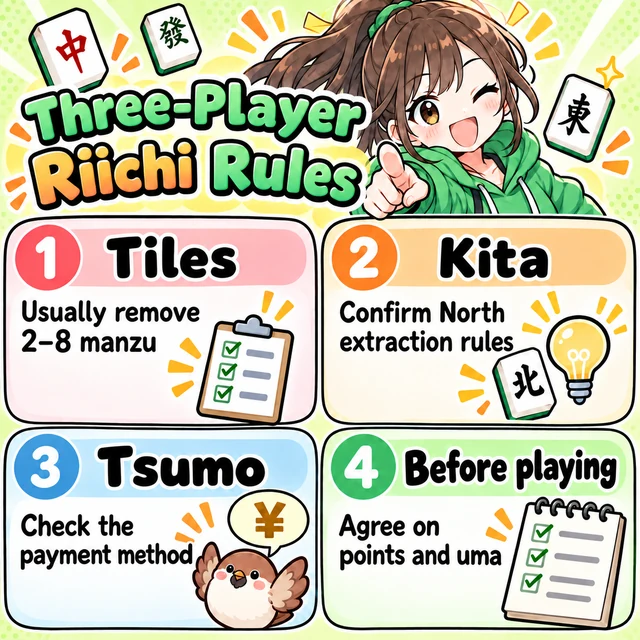 Three-Player Mahjong RulesCheck tsumo loss, North extraction and starting points
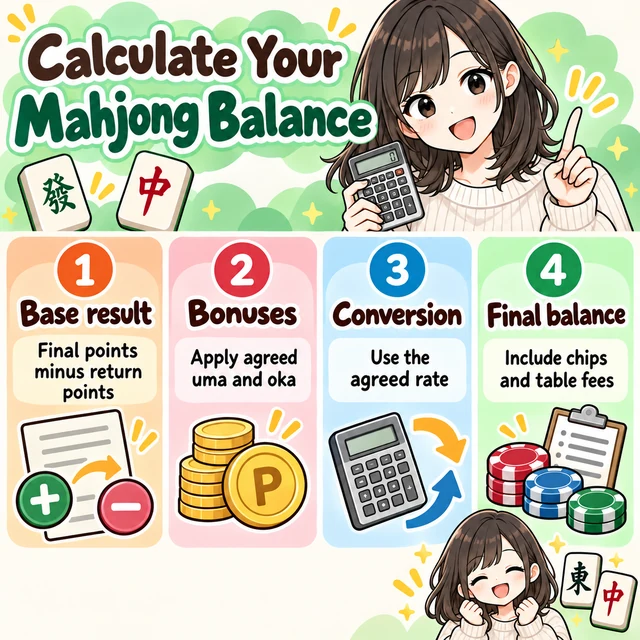 How to Calculate Mahjong Net ResultsCalculate from table scores through final net balance
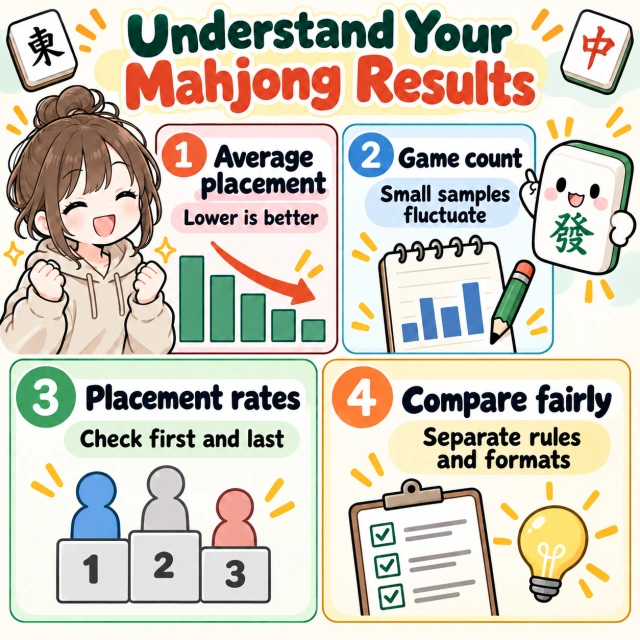 Understanding average placement in mahjongCompare performance under matching conditions
 Choosing a Mahjong Results TrackerWhat to check, including sanma support
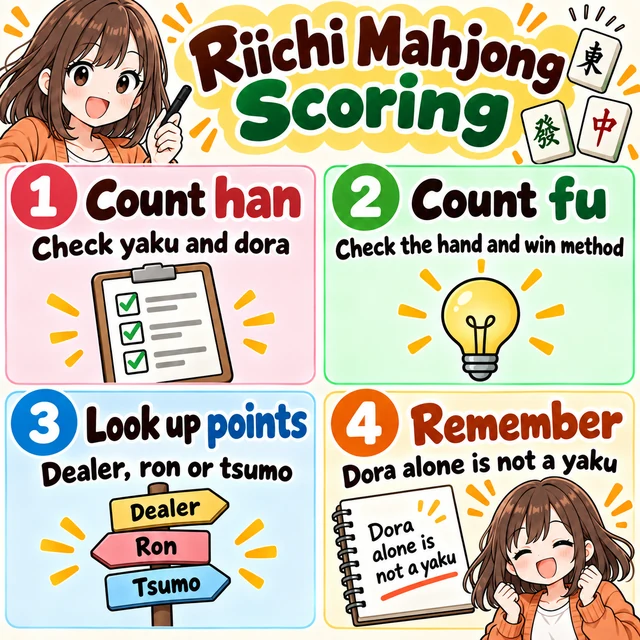 A straightforward guide to mahjong scoringReview han, fu and payment basics
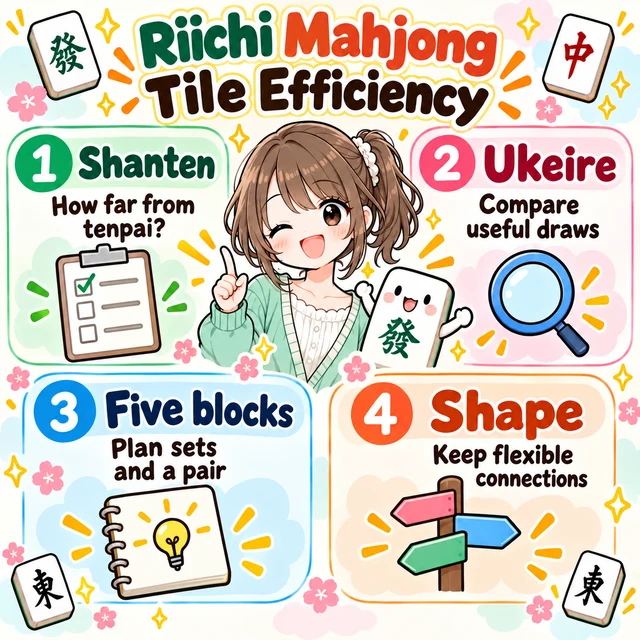 An Introduction to Tile EfficiencyUnderstand ukeire and five-block theory
 Mahjong defense and push-or-fold decisionsAssess safety using genbutsu, suji and kabe