


Start here
Calculate your balance
one step at a time.
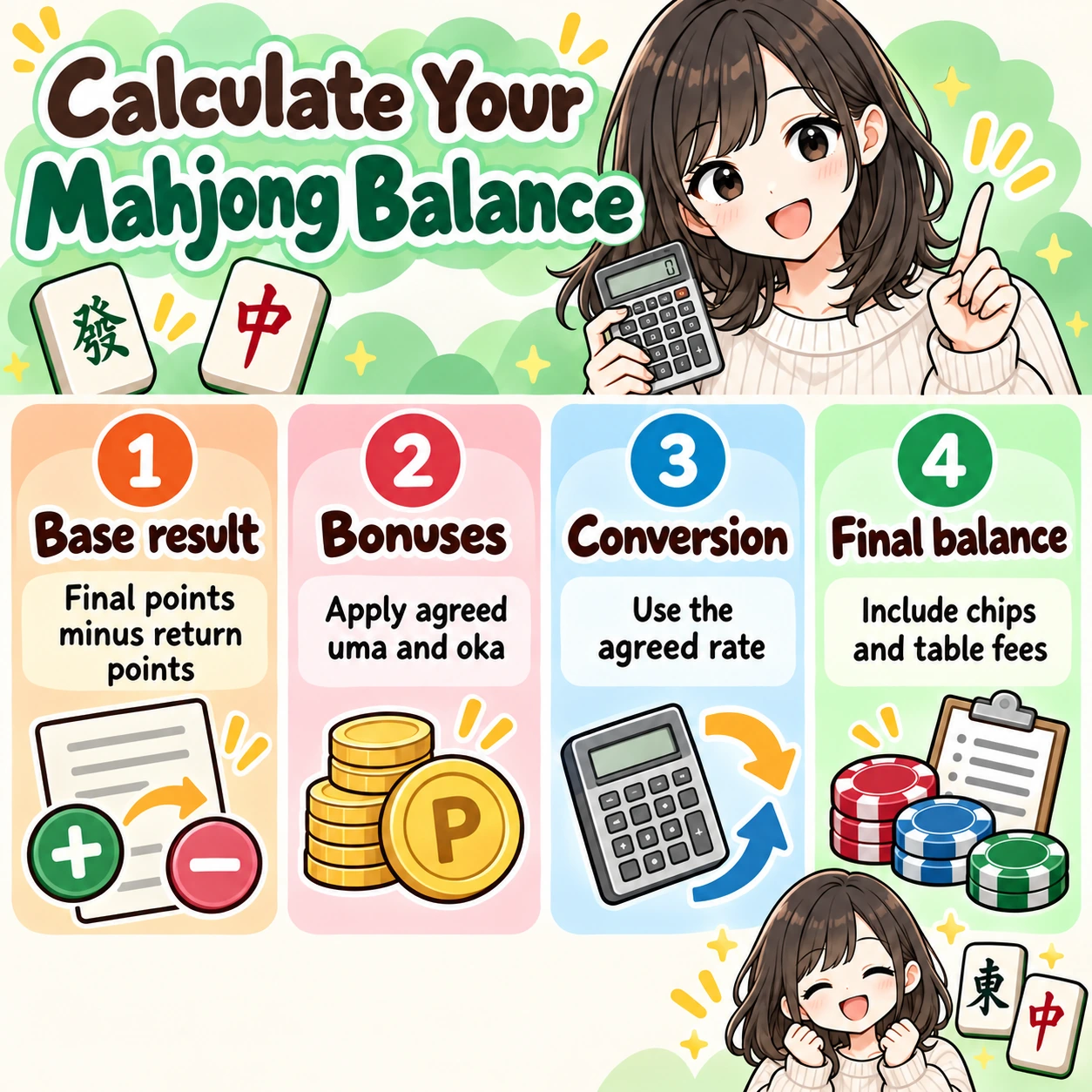
Separating the table-point result from the actual balance makes settlement easier to follow. Use the same agreed rules throughout the calculation.
Three things to remember
- From table points to game scoreApply uma and oka to the base score
- From game score to balanceApply the agreed conversion
- Include chips and table feesRecord additions and deductions separately
 Enlarge the illustration ↗
1. Calculation Steps and Terminology
Mahjong balance formulas
Base score = (final table points − return points) ÷ 1,000
Final game score = base score + uma + oka + other placement adjustments
Final balance = final game score × rate + chip balance − table fees
How to Calculate Mahjong Net Results
The basic mahjong balance calculation
- Check each player's final table points and placement
- Subtract return points from final table points to calculate the base score
- Add the uma for each placement
- Add oka to the first-place player
- Include any bankruptcy bonus or other adjustments to get the final game score
- Convert the final game score using the agreed rate
- Add chips received and subtract chips paid
- Deduct each player's share of table fees
- Add everything to get the final balance
The key is to keep table points, game scores, and actual balances in separate columns. Keeping intermediate values for each stage makes it easier to identify whether a discrepancy comes from the base score, uma, chips, or another item.
Rounding, tied placements, and bankruptcy bonuses vary by table. Confirm the rules in use before calculating.
Table points, game scores, and actual balances are different
| Item | Meaning | Example |
|---|---|---|
| Table points | Scoring sticks exchanged during play | 40,000 table points |
| Raw result points | The difference from return points, expressed in units of 1,000 | +10 |
| Final result points | The result after applying uma, oka, and other adjustments | +50 |
| Net balance | The value after applying the rate, chips, and table fees | +5,100P |
Treating 40,000 table points as an actual balance or adding a chip count directly to the final game score mixes units and produces incorrect totals. Label your columns with units such as “table points,” “score points,” and “P.”
Terms used in balance calculations
Starting points
Starting points are the scoring sticks each player receives at the beginning. With 25,000 starting points, everyone begins with 25,000. The starting total in four-player mahjong is therefore 100,000.
Return points
Return points are the baseline used to calculate the base score after the game. With 25,000 starting points and 30,000 return points, anything above 30,000 is positive and anything below is negative. Starting points and return points have different roles, so do not confuse them.
Base score
The base score is the difference between final table points and return points, usually converted into units of 1,000. With 40,000 final points and 30,000 return points, the difference is 10,000, so the base score is +10. Uma and oka have not yet been added at this stage.
Uma
Uma is a placement bonus or penalty added according to the final standings. Uma 10–20 generally means +20 for first, +10 for second, −10 for third, and −20 for fourth. The positive and negative amounts sum to 0.
Oka
Oka is a first-place award arising from the difference between starting points and return points. In a four-player game with 25,000 starting points and 30,000 return points, the four players' differences total 20,000 table points, or 20 score points, which are added to first place.
Rate
The rate converts the final game score into the units used for the actual balance. The examples in this article use 100P per score point. Everyone should agree on the unit and multiplier before playing.
Chips
Chips are settled separately from table points. Eligible wins and the value per chip depend on the rules. Do not mix them into table points or final game scores; after rate conversion, add or subtract chip count × value per chip.
Table fees
Table fees are the cost of using the table, separate from game results. Record them separately from wins and losses, then deduct each player's share at the end. After fees, the players' combined final balance is negative by the total amount of fees.
Quick reference for balance calculation items
| Item | Meaning | Example |
|---|---|---|
| Starting points | Raw result points | 25,000 starting points |
| Return points | Raw result points | 30,000 return points |
| Uma | Placement bonuses | +20、+10、−10、−20 |
| Oka | Winner’s bonus | Oka 20 |
| Rate | Net balance | 1 score point = 100P |
| Chips | Net balance | 1 chip = 100P |
| Table fee | Final balance | 400P per game |
In four-player mahjong with 25,000 starting points and 30,000 return points, each player's 5,000-point gap creates a total shortfall of 20 score points. Oka is the first-place award that fills this gap. In this example, add +20 to first place.
Distinguish table points, score points, and P
The 40,000 table points used during play, +50 score points entered on the settlement sheet, and +5,000 P after conversion are different values. Including units in every column prevents mistakes such as dividing +50 by 1,000 again or adding uma directly to 40,000 table points.
- Table points
- Scoring sticks on the table. They move after wins, deal-ins, and drawn hands.
- Raw result points
- An intermediate settlement value: final table points minus return points, usually expressed in units of 1,000.
- Final result points
- The result after applying uma, oka, and other placement adjustments to the base score.
- P
- The conversion unit used in this article's examples.
Oka adds the missing 20 score points to first place
In four-player mahjong with 25,000 starting points and 30,000 return points, the starting total is 100,000 while the return-point total is 120,000. The base scores therefore sum to −20. Returning those 20 score points to first place makes the combined base scores and oka sum to 0.
If starting points and return points are equal, this gap does not arise. Some tables do not use oka, so confirm the starting points, return points, and first-place award instead of relying on the name alone.
The difference between uma and oka
Uma adds or subtracts score points according to placement
Uma creates a scoring difference between final placements. Uma 10–20 usually gives +20 for first, +10 for second, −10 for third, and −20 for fourth. The four amounts sum to 0, so other players fund each player's positive amount.
Oka is awarded to first place
Oka is a first-place award used to settle the difference between starting points and return points. Its purpose differs from uma, which is attached to placement itself. Some rules use equal starting and return points, or do not use oka.
Why does 25,000 start / 30,000 return mean oka 20?
Giving each of four players 25,000 points creates a starting total of 100,000. Four return amounts of 30,000 total 120,000. The 20,000-point shortfall is converted at 1,000 table points per score point, so first place receives 20 score points.
For example, if everyone's base scores sum to −20, adding oka +20 to first place brings the total to 0. Oka is not an arbitrary extra bonus; it fills the gap between starting points and return points.
Do not confuse uma with oka
| Item | Uma | Oka |
|---|---|---|
| Basis | Final placement | Starting and return points |
| Who it applies to | Every placement | Usually first place |
| Example | 10-20 | Oka 20 |
| Purpose | Increase the difference between placements | Settle the return-point difference |
If you write only “+20 to first place,” it is unclear whether this means uma or oka. Use separate columns on the settlement sheet and record each once to avoid double-counting.
2. Calculate Balances for Four Players
A worked four-player balance calculation
Rules for this example
- 25,000 starting points, 30,000 return points
- Uma: +20 for first, +10 for second, −10 for third, −20 for fourth
- Oka: +20 to first place
- 1 score point = 100P
- 1 chip = 100P
- Total table fees of 1,600P shared equally by four players
Check final table points
Assume final table points of 40,000, 30,000, 20,000, and 10,000. Calculate each base score from the difference against return points, then apply uma and oka to determine the final game scores.
| Placement | Final table score |
|---|---|
| 1st | 40,000 table points |
| 2nd | 30,000 points |
| 3rd | 20,000 points |
| 4th | 10,000 table points |
Calculate the base scores
For each player, subtract the 30,000 return points from their final table points, then divide by 1,000. Final points of 40,000, 30,000, 20,000, and 10,000 give base scores of +10, 0, −10, and −20.
Add uma
Apply +20 for first, +10 for second, −10 for third, and −20 for fourth according to the confirmed standings. Uma alone sums to 0.
Add oka
Add oka +20 to first place. Everyone else receives 0 oka. This +20 offsets the −20 total of the players' base scores.
Calculate final game scores
| Placement | Final table score | Raw result points | Uma | Oka | Final result points |
|---|---|---|---|---|---|
| 1st | 40,000 table points | +10 | +20 | +20 | +50 |
| 2nd | 30,000 points | 0 | +10 | 0 | +10 |
| 3rd | 20,000 points | −10 | −10 | 0 | −20 |
| 4th | 10,000 table points | −20 | −20 | 0 | −40 |
The final game scores are +50 for first, +10 for second, −20 for third, and −40 for fourth. They sum to 0, confirming the calculation through uma and oka.
Apply the rate
At 100P per score point, multiply each final game score by 100. +50 becomes +5,000P; +10 becomes +1,000P; −20 becomes −2,000P; and −40 becomes −4,000P.
Add or subtract chips
Assume net chips of +5 for first, −1 for second, −2 for third, and −2 for fourth. Table fees are 400P per player.
At 100P per chip, these become +500P, −100P, −200P, and −200P. Check that chips received and paid sum to 0.
Deduct table fees
Each player pays an equal 400P share. Because table fees are separate from wins and losses, deduct 400P from everyone after calculating score points and chips.
Calculate the final balance
| Placement | Converted game points | Chips | Table fee | Final balance |
|---|---|---|---|---|
| 1st | +5,000P | +500P | −400P | +5,100P |
| 2nd | +1,000P | −100P | −400P | +500P |
| 3rd | −2,000P | −200P | −400P | −2,600P |
| 4th | −4,000P | −200P | −400P | −4,600P |
Follow the first-place player's balance from start to finish
STEP 1. Calculate the base score from final table points
First place finishes with 40,000 table points. With 30,000 return points, (40,000 − 30,000) ÷ 1,000 = +10.
STEP 2. Add uma
Add the first-place uma of +20 to reach +30 score points.
STEP 3. Add oka
Add the first-place oka award of +20 to reach +50 score points.
STEP 4. Confirm the final game score
The base score of +10, uma of +20, and oka of +20 give a final game score of +50.
STEP 5. Apply the rate
At 100P per score point, +50 × 100 = +5,000P.
STEP 6. Add chips
With five chips received, add 5 chips × 100P = +500P.
STEP 7. Deduct table fees
Finally, subtract the 400P table fee for a final balance of +5,000 + 500 − 400 = +5,100P.
- Base score:
(40,000 table points − 30,000 table points) ÷ 1,000 = +10 score points - Uma and oka:
+10 + 20 + 20 = +50 score points - Rate conversion:
+50 × 100P = +5,000P - Chips:
+5 chips × 100P = +500P - Table fees:
+5,000P + 500P − 400P = +5,100P
The calculation progresses from 40,000 table points to a base score of +10, a final game score of +50, a converted value of +5,000P, and a final balance of +5,100P. Keeping units separate and calculating one stage at a time is the foundation of avoiding mistakes.
Why do mahjong balances sum to 0?
Scoring sticks usually just move around the table
Scoring sticks change hands through wins and deal-ins, but the table's total normally does not increase or decrease on its own. Final table points plus any deposits should equal the total distributed at the start.
Uma sums to 0
The example's uma values are +20, +10, −10, and −20, totaling 0. Uma transfers placement points between players, so the amounts received and paid balance.
Oka fills the shortfall in the base scores
With 25,000 starting points and 30,000 return points, the four base scores total −20. Adding oka +20 to first place fills this gap, making the final game scores sum to 0.
Chips also sum to 0 when transferred between players
If one player receives five chips, the other players should collectively pay five chips. If all net chip counts do not sum to 0, check for missing entries or incorrect signs.
Including table fees makes the total negative
In this example, final game scores of +50, +10, −20, and −40 sum to 0. Uma and oka account for the table-point shortfall, so all settlement remains within the table. Net chip counts of +5, −1, −2, and −2 also total 0, leaving the combined balance before fees at 0P.
After fees, final balances are +5,100P, +500P, −2,600P, and −4,600P, totaling −1,600P. This negative amount matches the 1,600P in total fees, confirming that the calculation is correct.
Total score-point balance = 0
Total chip balance = 0
Total table fees = −1,600P
Total final balance = −1,600P
Try it in MemoJong: Set your rules and calculate balances →
3. Handle Rounding, Ties, and Special Adjustments
How do you handle fractional scores?
What is the base score for 35,700 points?
Rounding depends on the table's rules. With 35,700 final points and 30,000 return points, the difference is +5,700 table points, giving a base score of +5.7. Whether to keep +5.7 or round to an integer—and whether to round up, down, or to the nearest integer—depends on the agreed rules.
Rounding to nearest, up, or down depends on the rules
There is no universal rounding rule. Some tables round +5.7 up to +6, some retain decimals, and others use different rounding methods depending on placement. Always follow the rules in use at your table.
Do not round repeatedly during the calculation
If rounding is required, apply it once after entering the final table points. Rounding the same fraction again during P conversion compounds the error. If the chosen rounding method does not produce a zero total, an additional step such as assigning the remainder to first place may be specified. Record the agreed method instead of adjusting one player's result arbitrarily.
Some rules assign the rounding remainder to first place
If individual rounding causes the total game score to differ from 0, some rules add the remaining difference to first place. Keep rounding adjustments in their own column so it is clear who received how many score points.
How do tied placements affect uma?
Confirm placements first
When players finish tied, the rules may prioritize the seat closest to the starting dealer or split the placement bonuses equally. Identical final table points can therefore lead to different uma. Confirm the tie rule before calculating, and record both final table points and the confirmed placements.
Tiebreaks based on proximity to the starting dealer
One method resolves ties by the original seating order relative to the starting dealer. This assigns each player a distinct placement and the normal uma for that place.
Splitting uma for tied places
Another method adds the uma for the two tied places and divides it between the two players. For example, splitting second-place +10 and third-place −10 gives each player 0 placement points.
Tie handling varies by table
Final game scores change depending on whether ties are resolved by seating order or by splitting uma. Since this can cause settlement disputes, follow the method agreed before the game.
Confirm rules before playing
Ties are uncommon enough that their treatment may first become an issue at settlement. Stating the tie-breaking method on the rule sheet in advance helps avoid disputes afterward.
Bankruptcy bonuses, yakitori, and deposits
Bankruptcy bonus
A bankruptcy bonus transfers additional score points from a player whose points fall below a specified threshold to the player who bankrupted them or another designated recipient. Confirm who receives and pays it, and whether bankruptcy ends the game.
Yakitori
Yakitori penalizes a player who does not win a single hand during the game. The conditions for removing the penalty and the recipients of payment vary by table.
Riichi sticks and deposits
A 1,000-point stick left on the table after a riichi declaration is a deposit. Rules may award remaining deposits to first place or carry them into the next game. Avoid counting them twice in final table points.
Other special adjustments
Rather than lumping extra awards into “other adjustments,” record who paid whom and how many points changed hands. For a five-point bankruptcy bonus, enter +5 for the recipient and −5 for the payer together. An externally funded bonus will not sum to 0, so record its purpose and source.
Keep special rules separate from the basic calculation
First establish the base result using base scores, uma, and oka, then add special adjustments.
Pre-game checklist
- Starting points, return points, and whether first place receives oka
- Uma for all four places and the tie-breaking method
- When and how to handle the hundreds-place remainder
- Whether bankruptcy ends the game, and who pays and receives the bankruptcy bonus
- Chip eligibility, chip value, and how table fees are shared
Decide who receives leftover riichi sticks
Scoring sticks left on the table after riichi declarations are called deposits (kyotaku). Rules determine who receives any deposits remaining at the end or whether they carry into the next game. Record when they are settled so they are not counted in both table-point totals and final game scores.
4. Sanma and Competitive Mahjong Rules
How does sanma balance calculation differ from four-player mahjong?
The calculation follows the same basic sequence
In sanma, you still derive base scores from final table points, apply placement bonuses and oka, then add or subtract the rate conversion, chips, and fees as needed. The settings—such as starting points and placement bonuses—change, not the basic calculation sequence.
Starting and return points often differ
Sanma often starts at 30,000 or 35,000 points, unlike common four-player settings. Return points also vary by table. Do not automatically apply a four-player 25,000-start / 30,000-return setup.
Uma settings differ
Sanma has only first through third place, so uma must be set for three players. Distributions vary: some reward and penalize only first and third, leaving second at 0. Check how the three values are intended to total.
Oka also depends on the rules
Some rules calculate oka from the gap between the starting total and three return amounts; others define a separate first-place award. There is no universal fixed oka value for sanma.
Watch for sanma-specific chip rules
Some rules award chips for North extraction, red tiles, yakuman, tsumo wins, or other conditions. Record point settlement separately from chips and keep the main rules, including whether tsumo-loss payments apply.
Do not directly compare sanma and four-player balances
The number of players, point movement, placement bonuses, and chip conditions differ, so the same +30 score points can mean different things. Keep long-term sanma and four-player statistics separate. See how to manage sanma balances for more details.
How are M.League and competitive mahjong scores calculated?
Competitive mahjong also uses placement bonuses
Some competitive formats add placement bonuses to the result derived from final table points. Their purpose is to aggregate league performance, which differs from calculating actual balances at a regular table.
M.League score calculation
Under the official M.League rules, each player starts with 25,000 points. Points above 30,000 count positively, and the shortfall below 30,000 counts negatively. Placement adjustments are +50,000 for first, +10,000 for second, −10,000 for third, and −30,000 for fourth. Table points and placement adjustments are converted at 1,000 table points per score point.
For example, second place with 35,800 table points receives a base score of +5.8 plus a +10 placement bonus, totaling +15.8. This distribution differs from ordinary uma 10–20, so do not substitute that setting.
The purpose differs from ordinary uma and oka
At a regular table, game scores may be converted further into actual balances using a rate. M.League points accumulate as competitive results; they are not a system for calculating player-to-player balances with chips and table fees.
Professional organizations use different rules
Starting points, placement bonuses, ties, and rounding differ by organization and tournament. Use the published official regulations when calculating professional results.
Do not automatically apply ordinary uma 10–20
Assuming all mahjong placement bonuses are the same will produce results that differ from official scores. Check the specific allocation for first through fourth rather than relying on a rule name.
5. What to Check When Totals Do Not Match
How to troubleshoot a balance calculation
Check mismatched totals in this order
- Check that the four players' final table points plus leftover riichi sticks equal the total distributed at the start. Once riichi sticks have been settled, check only the four players' points.
- Do the positive and negative uma amounts balance?
- Has oka been added to first place more than once?
- Do chips received match chips paid?
- Do the players' fee shares add up to the total table fee?
It is more efficient to check final table points, base scores, uma and oka, rate conversion, chips, and fees in order than to work backward from the final balance. Finding the first stage where a discrepancy appears avoids rechecking every later step.
| Symptom | Where to check | Common cause |
|---|---|---|
| Game scores sum to a positive amount | Uma and oka | Missing negative uma or double-counted oka |
| Game scores sum to a negative amount | Base scores / oka | Incorrect return points or omitted oka |
| Mismatch only after rate conversion | Rate | Incorrect multiplier or sign |
| Mismatch after including chips | Chips | Chips received do not match chips paid |
| Mismatch only in the final balance | Table fee | Incorrect fee shares or number of players |
Common balance calculation mistakes
Confusing table points with score points
40,000 table points and +50 score points are different values. Subtract return points from table points and convert the result into units of 1,000 before applying uma and oka.
Confusing starting points with return points
With 25,000 starting points and 30,000 return points, 25,000 is the starting score and 30,000 is the baseline for calculating the base score. The difference funds oka.
Adding uma twice
A tool or app's final game score may already include uma. Decide whether you are calculating from final table points or recording a previously calculated score, and avoid adding the same uma twice.
Adding oka twice
If the first-place score already includes oka and you add another first-place award, the combined total becomes incorrectly positive. Check that oka matches the shortfall in the total base scores.
Adding chips to table points
Chips are exchanged separately from scoring sticks. Do not turn 40,000 table points into 40,500 or combine +50 score points and five chips into +55. After rate conversion, use a separate chip-count × chip-value column. This also lets you calculate performance without chips from the same records.
Treating table fees as part of playing performance
Table fees are the cost of using the table. Saving them separately from wins and losses lets you assess both playing results and actual costs. With a fixed fee per game, the total after fees also falls further as the number of games increases.
Combining sanma and four-player statistics
The number of players and range of placements differ, so identical score points can mean different things. Keep sanma and four-player statistics separate, combining only their actual balances when you need an overall total.
Directly comparing results under different rules
Different uma, oka, rates, chips, and fees can produce very different balances for the same placement. Analyze performance by comparing games played under the same main rules.
Rounding repeatedly
Rounding at the base-score, rate-conversion, and final-balance stages compounds errors. Round once at the stage required by the rules and keep the original unrounded values.
6. What to Record and How to Read Your Balance
Items to keep when recording mahjong balances
If you save only the final balance, you cannot recalculate it later or investigate why it changed. Record at least the following items for each game.
| Record | Why keep it? |
|---|---|
| Date | Summarize by month and year |
| Four-player / three-player | Separate game formats |
| East-only / hanchan | Compare games of the same length |
| Placement | Calculate average placement |
| Final table score | Recalculate base scores |
| Final result points | Analyze results including placement |
| Rate | Recalculate actual balances |
| Chips | Separate non-table-point balances |
| Table fee | Understand actual costs |
| Rules | Compare results under the same conditions |
Record starting points, return points, uma, oka, and rounding in the rules field too. You can use the mahjong rule sheet template for pre-game checks.
Keep statistics separate for sanma and four-player games, East-only games and hanchan, and games with different uma or rates.
Can a good average placement still produce a poor balance?
Average placement and balance do not always move together
Your actual balance can be negative even with a good average placement. The metrics describe different things and respond differently to rule settings.
Small base scores when finishing first
Many narrow first-place finishes improve average placement but produce small positive base scores. Conversely, a few large first-place finishes can substantially increase your balance.
Large losses when finishing last
Even with a low last-place rate, a single very large last-place loss can have a major effect on your balance. Check the average score for each placement as well as the placement distribution.
Poor chip results
Good placement results do not prevent your actual balance from falling if you pay more chips than you receive. Comparing balances with and without chips helps identify the cause.
The effect of table fees
Table fees apply each game, so their total grows with game count. A small positive balance from play can become negative after fees.
Mixing games with different rules
Combining games with different rates or uma makes the relationship between average placement and balance harder to understand. Analyze results separately by format and main rules.
Read several metrics together
Place average placement, balance, first-place rate, last-place rate, and game count side by side to see whether placements or point gains and losses changed. Avoid judging performance by a single number.
References and rules checked
Official competitive regulations show that settlement items also vary by ruleset. The worked examples illustrate the calculation process; use your own table's rules for actual settlement.
- M.League Organization: About M.League: an official rules example covering starting points and placement bonuses
- Saikouisen Nihon Pro Mahjong Association: Rules: examples of differences in rule adoption and settlement conditions
About the rules: Uma, oka, rounding, tied placements, bankruptcy bonuses, chips, and table fees vary by table and venue.
Related guides
 Understanding Average Placement
Read first-place rate, last-place rate, and balance under the same conditions
Understanding Average Placement
Read first-place rate, last-place rate, and balance under the same conditions
 Choosing a Mahjong Results Tracker
Compare paper, spreadsheets, and dedicated apps
Choosing a Mahjong Results Tracker
Compare paper, spreadsheets, and dedicated apps
 A straightforward guide to mahjong scoring
The order for checking fu, han, dealer status, and ron or tsumo
A straightforward guide to mahjong scoring
The order for checking fu, han, dealer status, and ron or tsumo
 Tracking Three-Player Mahjong Results
Track three-player uma and average placement separately from four-player games
Tracking Three-Player Mahjong Results
Track three-player uma and average placement separately from four-player games
 Mahjong defense and push-or-fold decisions
Use genbutsu, suji, and kabe to organize defensive decisions
Mahjong defense and push-or-fold decisions
Use genbutsu, suji, and kabe to organize defensive decisions